Why We Need Rituals

As a child, I absorbed fragments of what I later came to think of as The Language of Ritual from my grandmother.
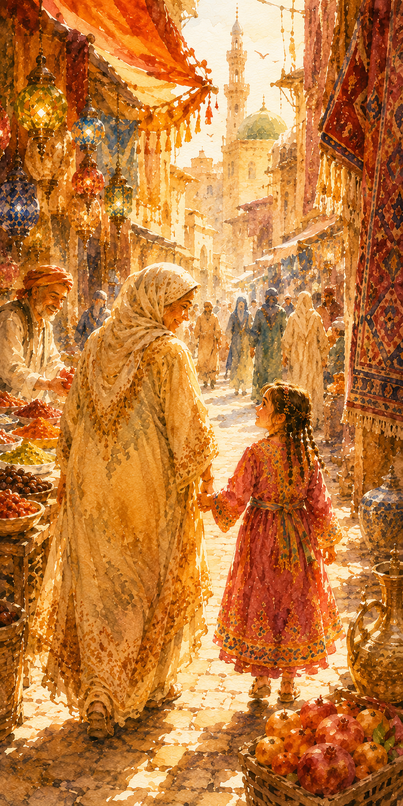
After dressing me in a bright national dress and braiding a dozen thin plaits, she would take my hand and lead me through the winding alleys of the oriental bazaar. The air carried spice and sunlight. Sellers smiled and offered fruit, soft dates, or pieces of warm flatbread wrapped in paper.
It became our small ceremony of entering the world.
My grandmother rarely spoke, yet her hands always communicated. Before meals or important moments, she would whisper a line in Arabic and move her palms, as if brushing away unseen heaviness. The movement carried meaning.
What she gave me was deeper than religion. It became a quiet inner compass. Leave the house clean. Return with gratitude. Small gestures repeated with care became a rhythm that still guides me.
These memories taught me something important: ritual is not only inherited. It can also be reimagined.
Yers later, while researching my historical novel, I found myself studying the symbolic systems of the Rosicrucians and Freemasons. Their ceremonies and symbols stirred something ancient and familiar. These were not spells. They were systems of transformation, practices that shaped awareness through movement, repetition, and metaphor.
The same thread continued through my study of Kabbalah and my growing fascination with Feng Shui, a tradition I had long felt drawn to. Despite their cultural differences, both offered ways to create harmony between inner life and the outer world.
I was not choosing between East and West. I was learning to listen to both. This openness led me to a deeper question: why do rituals work, and why have they endured across centuries?
After exploring the cultural roots of ritual, I began to wonder what gives symbolic action more power than rational advice or abstract insight. Why can simple gestures, performed with intention, bring clarity and peace that the mind alone cannot offer?
Studies suggest that ritual can reduce anxiety, support grief, improve focus, and create a greater sense of stability. Yet beneath these measurable effects lies something deeper: embodied meaning.
Consider the custom of presenting a diamond as a gesture of devotion. On the surface, it expresses love. Yet beneath that, it functions as a ritual object. A crystal formed under pressure, rare and enduring, becomes a symbol of intention. The act itself carries meaning.
Ritual transforms private emotion into shared recognition. It turns meaning into matter. We find it in weddings, protests, tea ceremonies, therapy, even in the way we greet one another. These patterns shape identity and belonging.
Once I noticed this, I began to see ritual everywhere: in the way we light a candle, raise a glass, or pause before speaking. These gestures help us locate ourselves. They offer an inner compass. In a fast world, they slow us down. In a noisy one, they help us listen.
Rituals have always marked transition. They help us cross thresholds between inner and outer, chaos and meaning. They are older than language.
Ritual lives not only in culture or belief. It exists in the symbolic language of the psyche. It is the way the body gives form to inner truth. When joined with reflection, it becomes transformation.
Across cultures, ritual bridges the visible and invisible. Whether through a drumbeat in Siberia, a tea ceremony in Japan, or the lighting of Sabbath candles, symbolic action gives shape to emotion. Even in secular life, we mark transitions. We light candles, raise glasses, stand in silence. These gestures are not empty. They are how meaning becomes lived experience.
Before ritual entered my practice, I often rewrote until the page felt sterile. After I began to pause, light a candle, and ask a single question, words returned with flow and presence. That shift from analysis to embodiment became a threshold. Ritual stopped being an idea and became something lived.