The Marsh Floor

The lift in the west wing is old enough to keep its own weather.
Inside, the air smells of oil and rust, and the glass stays wet with a fine skin of condensation.
Dr Lantern steps in, whistling ‘Moon River’ softly through his teeth, a lemon lollipop tucked in his cheek, and a glass vial in his hand. A neat label reads: Theatre 3, 19:13.
In the vial, an orb the size of a plum stone beats like a pulse. His own orb hovers at his shoulder, a fist of flame that casts no shadow, keeping a hand’s breadth from his white coat.
The Repository waits below, a cold archive of held lights. He presses the button. The car descends. His orb dims and brightens to the tune, keeping time with the car’s slow drop.
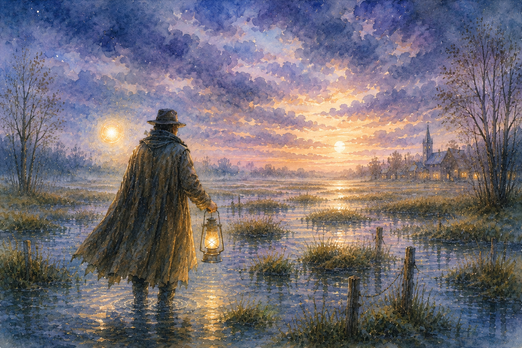
The doors open onto black water and reeds under a full moon. Not the Repository. His whistle fades. ‘Moon River’ is still in his head. His orb drifts ahead by a pace, pausing when he does, its edge blurring whenever he hesitates. In his palm, the vial warms, then cools, as if breathing. A path of flat stones shows in the shallows, one by one, as if listening. The orb tilts towards the reeds; the stones seem to answer its lean.
He steps out. Peat and salt. The glass sweats in his hand. Halfway across, the light in the vial strains for the water, and the next stone sinks under a skin of weed. He steadies, breath held.
The marsh light rises at the edge of his vision. The air thins around it.
“Oh, Will-o’-the-Wisp,” the doctor says, his orb drawn small at his shoulder, as if deferring to the older light.
“The marsh keeps a ledger,” it says. “Lanternman, you owe me one.”
“Again? I have paid you already.”
“You borrowed from the leaving lights that cross my water. The road boy you bought a dawn for with your own fire. That entry stands. Pay before moonset.”
The doctor thinks of the patient in Theatre 3, skin grey under the lamp, heart thread-thin. He took this light to hold that life steady. If the patient fulfills the conditions, there can be hope; joy may fit him clean again.
The wisp hums, “He should have died. Pay with his light and be done.”
Dr Lantern looks to the moon and lets the tune he whistles carry him: river, moon, a promise just around the bend. He stops. “No, Wisp. My debts are mine.”
“Then name your payment.”
He slips the lollipop from his mouth; the stick taps his teeth. He holds it between two fingers.
“Taste,” he says. “Lemon.”
A tiny sweet rests on his palm, yellow and clear. He sets it on his tongue. It gives him nothing, no sun, no sting. The price takes. His orb steadies too, warming the skin by his cheek.
The stones firm. The path goes quiet. The doctor returns to the lift. He still has the vial.
He rides down to the Repository.
Cool light, the smell of paper and steel. He logs the vial, notes: eligible for return; conditions: rest kept, care kept, errors owned. He sketches a small lantern beside the time and slots the vial home. He summons the gold of lemon and finds only air.
He chews a memory already gone. It joins the others he has paid in: coffee, rain, a name he cannot quite hear.