Stories

The Girl Who Built Houses
I remember myself very early. I must have been three or four.
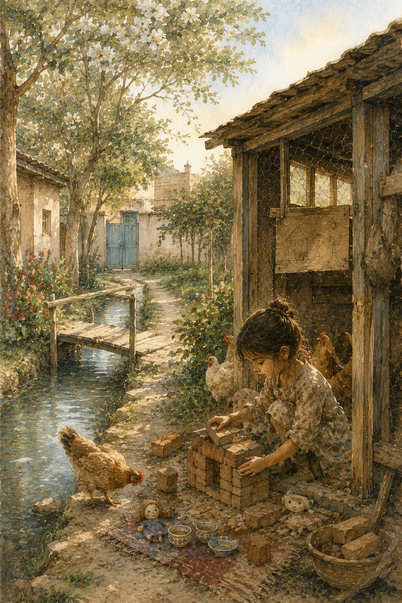
We lived in Andijan, in Uzbekistan. Through the middle of our courtyard ran a narrow irrigation canal — an aryk, as we called it — crossed by a bridge.
It marked the invisible border between my grandmother’s territory and ours, meaning my parents’.
On my grandmother’s side stood a wooden outhouse and a chicken coop.
And it was there — yes, exactly there — that I built my first home.
First, the outhouse. I covered the hole with a plank. Resourceful child that I was, I somehow found bricks, carried them over, and arranged a tiny table and chairs. I brought dishes, dolls, treasures.
I cannot remember how long my little kingdom lasted, though I vividly remember my grandmother opening the door one day and discovering my sanctuary.
Horror. Outrage. Immediate eviction.
The chicken coop became my next attempt. My mother proved equally unconvinced by my architectural ambitions.
In short, I was stripped of my real estate. The message was clear: no separating yourself from the family, learn to live in the collective.
Yet I was stubborn. Shared space never quite suited me. I always longed to build a small corner of the world that felt entirely my own.
Throughout childhood, I built houses. Tiny clay bricks for dolls. Shelters in the garden. Secret corners stitched together from imagination.
And somehow, as life unfolded, I found myself creating homes again and again, in every country and every place I lived.
Perhaps this is how imagination works. First we build a life inwardly. Then, little by little, reality catches up.

The Boy Who Named a Country
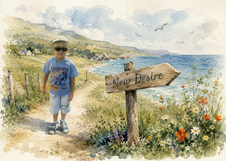
The country was founded by a little boy who accidentally renamed New Zealand.
Wooden Shuttle
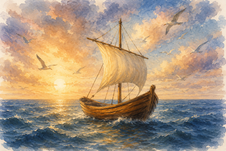
Like the shuttle itself, it has travelled across decades to find a place of rest.